
Understanding Trauma Responses: Making Sense of How We Cope and Survive
If you find yourself reacting in ways that feel out of proportion, shutting down when you want to speak up, or struggling to feel safe even when nothing is wrong, your nervous system may be doing exactly what it was designed to do.
 Amy Lynch
There is a moment many people describe in therapy. A moment of recognition that arrives with both relief and grief. It usually sounds something like: "You mean I'm not broken? I'm just responding to what happened to me?"
Yes. That is exactly it.
Understanding how trauma affects the nervous system does not make the pain go away. But it can change the story you tell yourself about why you are the way you are. That shift, from self-blame to self-understanding, is often where healing begins.
What is a trauma response?
When we encounter something threatening, our nervous system activates a survival response. This happens automatically, below the level of conscious thought. The brain's threat-detection system sends out an alarm, and the body prepares to respond.
Most people are familiar with fight or flight: the surge of adrenaline that prepares you to confront a threat or run from it. But there are other responses too.
Freeze is when the body goes still, sometimes dissociating or going numb. This often happens when fighting or fleeing does not feel possible. Fawn is moving toward the threat, appeasing or placating, trying to make yourself safe by making others comfortable. This is particularly common in relational trauma. Collapse is a deeper shutdown, sometimes described as a last-resort response when all other options feel unavailable.
None of these responses are choices. They are the body's best attempt to keep you alive.
Why do trauma responses persist?
Trauma responses do not automatically switch off when the danger is gone.
The nervous system learns from experience. If you grew up in an environment where you needed to stay hypervigilant, your system learned that hypervigilance keeps you safe. If shutting down was the only way to survive something overwhelming, your system learned to shut down quickly and efficiently.
These patterns become encoded, not just in memory, but in the body. They show up as difficulty trusting people even when there is no clear reason not to, reacting strongly to things that seem small to others, feeling numb or disconnected, struggling to feel safe in your own body, or exhaustion from always being on alert.
This is not weakness. It is the nervous system doing its job in a context where the original threat is no longer present.
Trauma responses go beyond fight, flight, freeze and fawn
When people learn about trauma responses, the conversation often starts and ends with fight, flight, freeze, and fawn. These are real and important. But they do not capture the full picture of how trauma can show up in daily life.
Trauma can also look like:
Emotional overwhelm or difficulty identifying feelings. You may find yourself flooded by emotion with little warning, or conversely, struggling to name what you are feeling at all. Both can be ways the nervous system manages what feels like too much.
Hypervigilance and feeling constantly on guard. A persistent sense that something is wrong, scanning for danger even in safe environments, or finding it difficult to relax. This is the nervous system doing its job, even when the original threat is long past.
Disconnection, numbness, or withdrawal. Feeling detached from yourself, from others, or from life in general. This can be a form of protection, a way of creating distance from pain that once felt unbearable.
Changes in sleep, concentration, and energy. Difficulty falling or staying asleep, trouble focusing, or a persistent exhaustion that rest does not seem to touch. These are not signs of laziness or weakness. They are signs of a nervous system that has been working very hard for a very long time.
Difficulties with trust, boundaries, and relationships. Finding it hard to let people in, struggling to know what you need or to ask for it, or noticing patterns in relationships that feel confusing or painful. These often have roots in earlier experiences of harm or rupture.
The key message in all of this is the same: these responses make sense in the context of what you have been through. They are not character flaws or signs that something is fundamentally wrong with you. They are the nervous system's attempt to protect you, shaped by experiences that were real and that mattered.
The window of tolerance
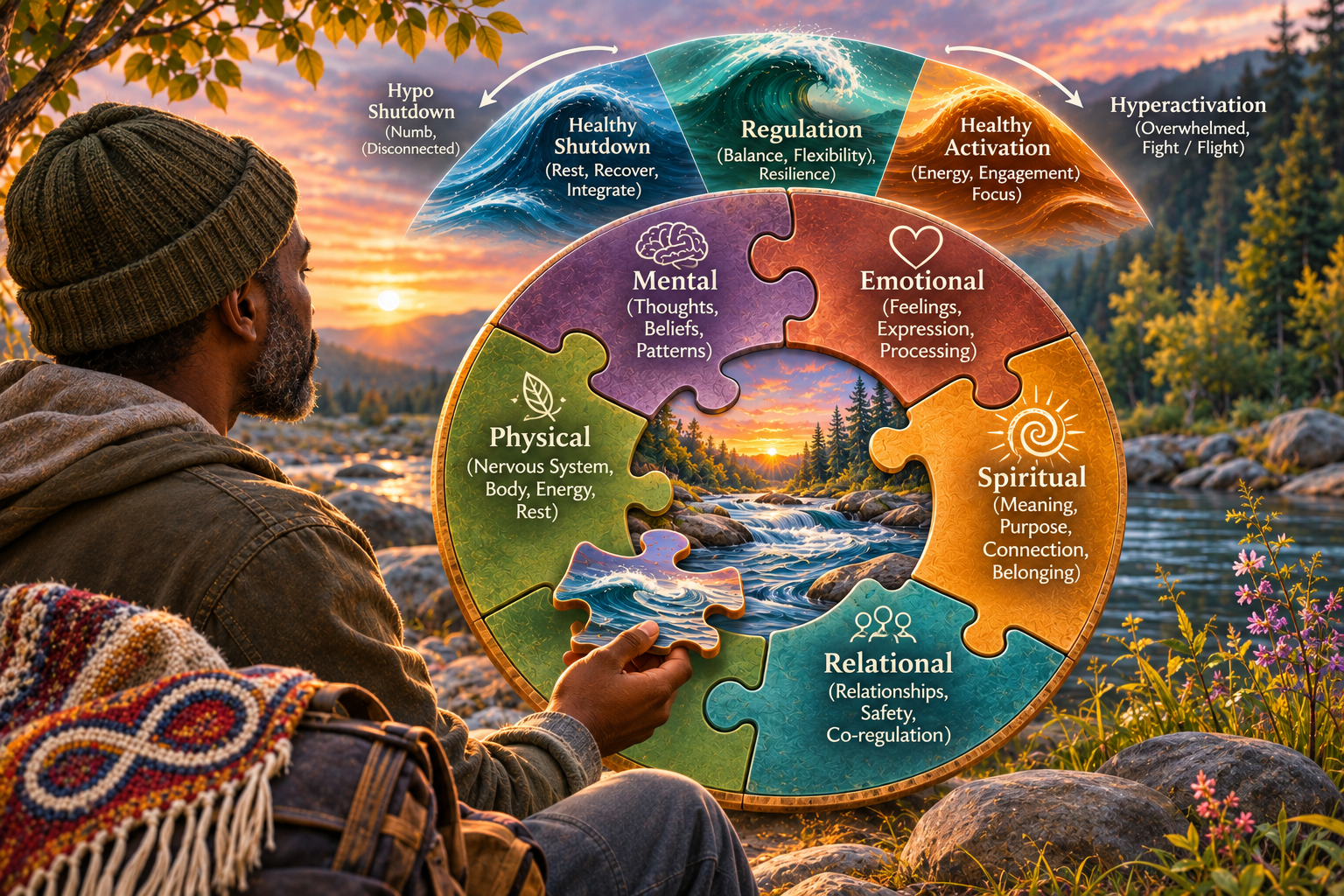
One concept I find helpful to share with clients is the window of tolerance, a term developed by psychiatrist Dan Siegel to describe the zone in which we can function, process, and connect.
When we are within our window, we can think clearly, feel our emotions without being overwhelmed by them, and engage with others. When we move outside it, either into hyperarousal such as anxiety, panic, or rage, or into hypoarousal such as numbness, shutdown, or dissociation, our capacity to process and connect narrows significantly.
Trauma often shrinks the window. Things that would not have triggered a strong response before can now push us outside it quickly. Part of trauma-informed therapy is gently, gradually widening that window, building the capacity to stay present with difficult feelings without being overwhelmed.
What trauma-informed therapy offers
Trauma-informed therapy does not mean we spend every session talking about what happened. In fact, for many people, revisiting traumatic events in detail before the nervous system has enough capacity to tolerate it can be retraumatising rather than healing.
Instead, trauma-informed work tends to focus on a few things. Safety comes first: building a therapeutic relationship where you feel genuinely safe enough to explore difficult material. Stabilisation means developing tools and resources to help regulate your nervous system. Understanding your patterns means making sense of why you respond the way you do, with curiosity rather than judgment. And gradual processing, when you are ready and at your pace, means beginning to make meaning of what happened.
I want to be transparent: I am a Registered Psychotherapist (Qualifying) with training in trauma-informed practice and CCTP certification. I do not offer specialised trauma treatments such as EMDR or Somatic Experiencing. If your needs call for that level of specialised care, I will support you in finding the right fit.
You are not your trauma responses
Your trauma responses are not your identity. They are adaptations, intelligent and creative responses to circumstances that were beyond your control.
They may have served you well once. They may be causing you difficulty now. Both things can be true.
Healing does not mean erasing what happened or becoming someone different. It means developing more choice, more capacity to respond to the present moment rather than the past.
If you are curious about what trauma-informed therapy might look like for you, I would be glad to connect. A free 15-minute consultation is a low-pressure place to start. You can also learn more about how I work or explore my services.
Amy Lynch is a Registered Psychotherapist (Qualifying) and Certified Clinical Trauma Professional (CCTP) practising virtually across Ontario. She offers wholistic, trauma-informed counselling rooted in relational, somatic-informed, and narrative approaches.
Written by
Amy Lynch
MACP · RP (Qualifying) · BA Mus (Music Cognition) · RYT-200 · CRA-RP · RCM Certified Teacher